Motorcycles
Where do you start in your quest for a suitable motorbike? Ideally the motorbike will meet all the requirements you set for it. In reality it is a compromise between different criteria. For our first idea The Adventure Motorcycle Handbook was a logical start. In the AMH are important requirements an ideal overland bike should meet as well as a top 10 of suitable motorcycles including the Yamaha XT.
- The considerations choosing a suitable bike are:
Weight of the bike: For driving on the highway a heavier bike is preferable to a light bike. This will provide for a calmer ride while having enough power at higher speeds. For off-road work a light bike will be better for maneuverability, and enough power and torque at low RPM are desirable. - Amount of cylinders: The more cylinders a bike has the smoother the engine will run and the more robust the engine will be. (A cylinder can fail but the other cylinders will still keep the engine going.) But the less cylinders a bike has the lighter it will be.
- Electronics: Advantages of electronics on a bike are a more economic engine functioning (electronic injection engine), security (starter blocking system) and safety (tilt switch to shut off the engine when the bike falls). A disadvantage is that in remote locations often the latest technologies are not known, not repairable and no spare parts for it are available. Therefore you will have to take spares yourself and have enough knowledge of mechanics to be able to repair your bike wherever you are.
- Catalyst: In a lot of countries around the world unleaded fuel can hardly be found. If your bike has a catalyst and you use leaded fuel, the lead will clog the catalyst which is in the exhaust making it impossible for exhaust gases to escape, eventually shutting down the engine.
- Compression ratio: The compression ratio determines the lowest octane level of the fuel you can use. The higher the compression ratio the higher the minimum octane level the engine can use. In The Netherlands the fuel has a standard octane level of 95 (Euro 95) But especially in Third World countries the octane level is often much lower and can even drop below 80. With a compression ratio of about ten or eleven you will probably have no problems.
- Does it feel good? Very important question, after all you will spend a long time sitting on your bike. (A tip from Arjan Brouwer, 14 times Paris-Dakar and 7 times from north to south Africa by bike: Buy a pair of cycle pants with a cushion for the buttocks.)
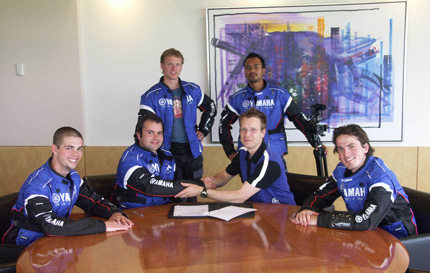
The choice for a suitable bike is a compromise between all the technical aspects listed above and of course availability and budget. For us, being students, the latter probably are the most important considerations. But confidence built by experiences of a.o. Sjaak Lucassen, that took his Yamaha R1 and took five years crossing virtually the whole world, taught us that it doesn’t matter all that much what bike you have as long as you have one! Armed with this knowledge Bogdan and Doenan went to the Motorcycle convention in Utrecht, NL, as early as November 2006, to see what was available on the market and what companies would be interested in providing for 3 motorcycles. Of course at that time, 7 months before departure, it was to early to sketch a good image of the total expedition, the media coverage and the advantage to a potential sponsor, to the motor producers. What became apparent on the convention was which companies were happy to be associated with student initiatives like ours. Yamaha had the most enthusiastic reaction by far. When a couple of months after the convention we had more solid plans and progress on our expedition, the talks with Yamaha became more serious. In conference with Yamaha we then were able to choose our motorbike.
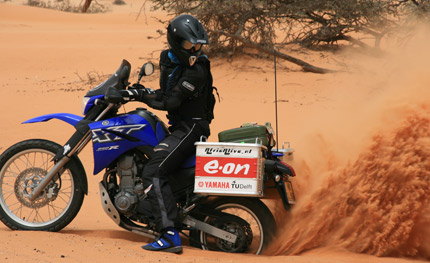
The considerations we made resulted in the choice of the Yamaha XT660R Dakar. Yamaha Netherlands were willing to put at our disposal three motorbikes. The ‘Yamaha XT660R Dakar’ is the latest version of the XT family that has been existing for over 25 years. The XT has a proven state of record when it comes to durability and robustness. This one cylinder engine thus combines robustness with lightweight. The bike is equipped with the latest electronics which pose a certain threat but since we have enough knowledge on the bike to perform repairs and Yamaha provided us with sufficient spare parts we are confident this bike will get us through Africa. The XT660R has a 48 hp engine and can reach a maximum speed of 170 km/hour (without cases) and comes with suitcases, a large windshield and a robust bash-plate. De bikes had to be broken in for the first 1000 km with a special break in engine oil. (Yamaha is one of the few companies that still deliver bikes with break in oil in order to prolong its economical lifespan.) After the break in period the bikes got serviced for the final time before departure. On June 7 we were ready to roll.
To prepare ourselves good for what was to come, Doenan, Alexander and Bogdan have followed an off road training. Under here a compilation can be found of a day of hard work in the Dutch polder.