Bangui University, Central African Republic
After arranging for the boat in Cameroon it was decided to visit the
Central African Republic since it is a country that very few people know
anything about. The country is very poor and has put a large effort in
arranging for our security by arranging a full military escort and a warm
welcome at the Bangui University. Therefore it was decided to send Bogdan
and Doenan to the CAR to lay the first bridge between the Technical University
of Delft and the University of Bangui.
The university of Bangui is an extensive complex of buildings with faculties
on the field of medicine, social studies, technology and economics. The
warm welcome that awaited AfricAlive in the CAR has not been surpassed
by any other project. The reception by the rector of the university was
extremely friendly and the rector was very positive about our initiative.
He was instantly indicating that a cooperation and exchange between the
TU Delft and his university would indeed result in a fruitful synergy.
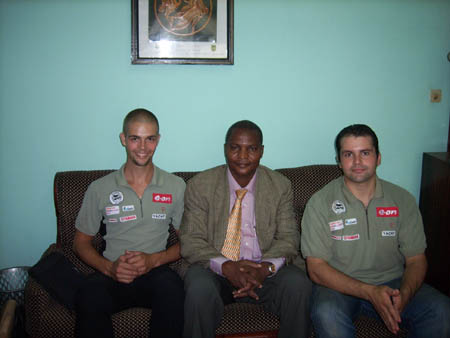
Doenan and Bogdan meet the rector of the University of Bangui.
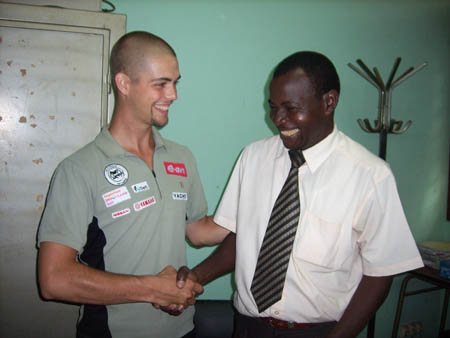
Doenan bij het interview met de Vice-Decaan van de Universiteit van Bangui.
Experiments on the Atrofa plant are being executed in the Chemistry laboratory. This robust plant can grow under virtually any circumstance. The seeds of the Atrofa plant are used for the extraction of bio-diesel. In the chemistry lab fundamental research on the ideal growing conditions of the Atrofa is going on, as well as research on the best extraction methods for bio diesel and the energy content of the extracted oil. Besides that methods of oil extraction in rural areas are developed in the same laboratory. That way the rural population can benefit from the research performed at the university.
Research into water quality and management is being conducted in the biological laboratory. Water often rains down in large quantities and for short periods of time in the CAR. The aim is to produce water management solutions that can be applied on a micro scale in order for them to manage water supply and demand. The aim is to have sufficient water all year round and to prevent floods from destroying the crops and houses. In that same lab ongoing research is conducted into water filters that can be built and used in rural areas. The micro implementation philosophy is obeyed here as well. An example is a water filter built from sand, ground charcoal and ashes. This filter can be produced anywhere and ensures clean drinking water for rural people in the most remote locations of the country, thereby reducing the risks of epidemic diseases.
All in all we were surprised at the students' inventive spirit and widespread attention for sustainable technology. The inventiveness of the students is a direct result of their lack of means. The instruments used are terribly outdated or have been 'homebrewn' by the students. There is no internet on the campus but an optical fiber network is under construction. The network is almost finished but has been halted for the past eight months due to a lack of financial resources. It's remarkable how inventive these students are in solving their problems, and how their solutions differ from ours.
The above findings support our opinion that a cooperation and an exchange of students between these two universities is not a matter of charity and humanitarian development but indeed can be very useful to European students to develop their ingenuity and perseverance.